Could your vibe-coded app bankrupt your business?
A working application is a milestone. A good application lets your business change direction without turning every new idea into an expensive project.
That difference can affect your entire company.
Imagine launching a booking platform. The demo looks great, customers sign up, and everything works. Then a promising client asks for team accounts, a different pricing model, and a connection to their existing system.
Those requests sound reasonable. But each one touches so many parts of the application that the team hesitates to change anything. Sales waits. Operations invents workarounds. Customers wait for promises you cannot deliver quickly.
A software problem has become a business problem.
The price of the next change
Software architecture is simply how the parts of an application fit together. For a founder, its value is practical: how difficult will it be to change the product when the business needs something new?
With a clear structure, a change can stay relatively contained. With a tangled structure, a small request can spread across the application, creating more work and more chances to break something.
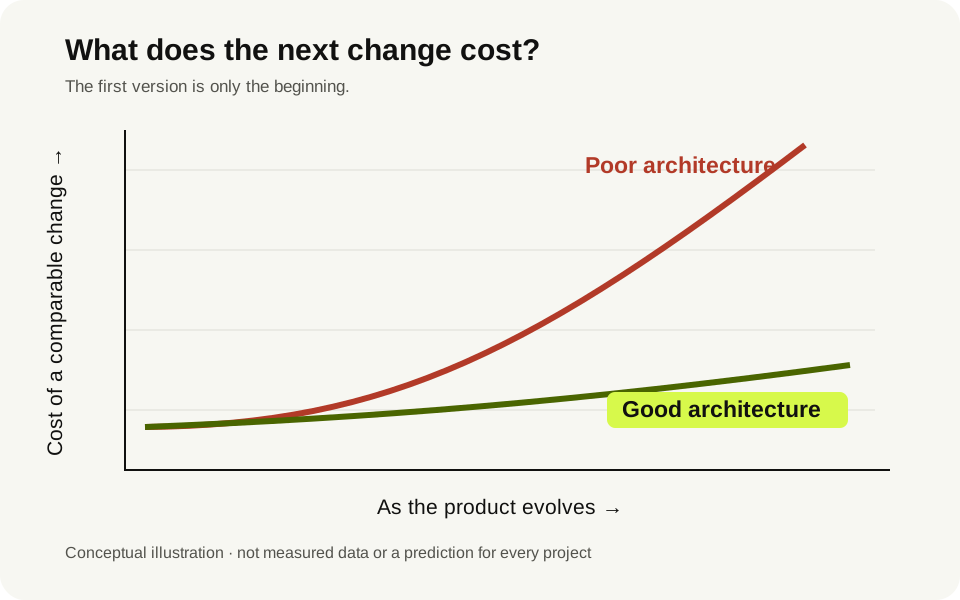
Good architecture does not make change free. It helps keep change affordable. It also does not require months of planning: the goal is enough structure to support the next steps, with room to improve as you learn.
Your runway pays for the friction
For a young company investing in its first product, this matters enormously. You are still discovering what customers need. Changing direction is part of the work.
If every adjustment takes weeks, your budget buys fewer experiments. A delayed integration can cost a contract. Manual workarounds consume your team’s time. A rewrite can use up money you expected to spend on growth.
Poor architecture does not automatically bankrupt a company. But when software is central to the business, repeated delays and rising costs can contribute to running out of cash before the business becomes sustainable.
In a market moving quickly with AI, the ability to respond matters as much as the ability to launch.
AI makes experience more valuable
AI can generate code, suggest designs, and help you explore an idea quickly. Those are useful capabilities. They do not remove the need for experienced judgment.
An AI-generated answer can sound convincing while relying on assumptions that do not fit your business. Someone still needs to challenge those assumptions, understand the trade-offs, and check whether the solution will remain manageable as requirements change.
That is where experience matters: recognising which shortcuts are reasonable today and which ones are likely to become expensive tomorrow.
The ability to generate an application is not the same as the ability to evaluate it.
A demo is the start of the conversation
Tools such as Google AI Studio, Base44, and Lovable can help you put an idea in front of an investor, take a prototype to a conference, or test a workflow with potential customers.
But a successful demonstration does not establish that the application is ready to become the foundation of your company.
This is not a verdict that every application built with these platforms will fail. The question is whether your particular solution can support real users, changing requirements, and ongoing ownership. Even Lovable’s own guidance for founders explains that fast AI-assisted development can skip important review steps and that founders still have responsibilities before launch.
You do not need to learn architecture terminology or integration patterns to make a better decision. Before investing further, ask: who can change this application, what happens when our needs change, and can another team take it over?
Security and maintenance deserve attention too. A working screen cannot tell you whether those needs have been met.